AWS Bedrock Agents vs LangGraph: A Practical Decision Guide
A builder-focused comparison for choosing between AWS Bedrock Agents and LangGraph when designing tool-using, approval-aware agent workflows.
AWS Bedrock Agents vs LangGraph: A Practical Decision Guide
Choosing an agent framework is less about which one is more powerful and more about where you want control to live. AWS Bedrock Agents gives you a managed AWS service for building agents that can use foundation models, action groups, knowledge bases, and AWS security controls. LangGraph gives you a graph-based application framework for building stateful, controllable agent workflows in code.
Both can run useful agentic systems. They solve different ownership problems.
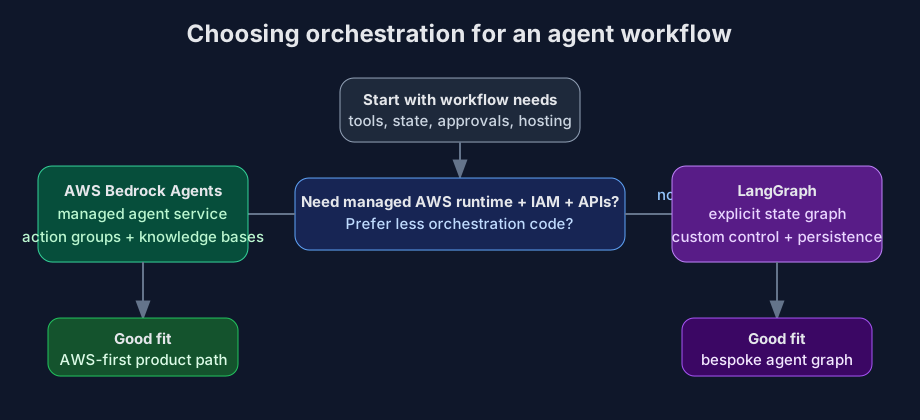
Quick comparison
| Question | Prefer AWS Bedrock Agents | Prefer LangGraph |
|---|---|---|
| Where should the runtime live? | Managed AWS service | Your app, worker, or platform |
| Who owns orchestration logic? | Bedrock agent configuration plus action groups | Your graph nodes, edges, state, and code |
| Best first use case | AWS-first assistant over enterprise APIs and knowledge | Custom multi-step workflow with explicit state |
| Human approval style | Add approval around API/action boundaries in your app process | Model approval as graph interrupts, review nodes, or gates |
| Portability | Tied to AWS Bedrock patterns | Python/JS app architecture you can host in many places |
| Main tradeoff | Less low-level control | More code and operational responsibility |
Choose Bedrock Agents when AWS is the product boundary
Bedrock Agents is a strong default when your team is already building inside AWS and wants agent behavior close to AWS identity, networking, logging, and service integration. The official Bedrock Agents docs describe agents as a way to automate tasks by orchestrating interactions between foundation models, data sources, software applications, and user conversations.
Use it when the agent mostly needs to:
- answer from approved enterprise knowledge sources;
- call well-defined business APIs;
- operate under AWS IAM, VPC, and account boundaries;
- fit existing AWS deployment and compliance workflows;
- reduce custom orchestration code.
A practical example: an internal support agent that answers from a product knowledge base, creates a ticket through an action group, and escalates to a human when confidence is low. The main logic is not a novel graph algorithm. The main requirement is controlled access to company systems.
Bedrock Agents can also be useful when the team that will operate the system is stronger in AWS than in agent framework internals. You still need design discipline: narrow actions, clear input schemas, logging, testing, and approval for risky operations. But you are not building the whole agent runtime yourself.
Choose LangGraph when control is the product boundary
LangGraph is a better fit when the workflow shape matters: branching, retries, persistent state, human review points, long-running tasks, or multiple specialized steps. The LangGraph docs frame it around controllable agent workflows, persistence, and human-in-the-loop patterns.
Use it when the agent needs to:
- move through explicit states such as
triage,plan,act,review, andpublish; - resume after a human decision or external event;
- run different paths for different risk levels;
- mix models, tools, queues, and services outside one cloud boundary;
- expose the workflow as code that developers can test and refactor.
A practical example: a code-review agent that inspects a pull request, runs tests, files inline comments, waits for maintainer approval, and only then opens a follow-up patch branch. That workflow benefits from a graph because each state has different permissions, artifacts, and exit criteria.
LangGraph gives you more control, but that control has a cost. You own deployment, secrets, retries, observability, queueing, and versioning unless you adopt managed pieces around it. For builders, this is often the right tradeoff when the workflow is the core product.
Decision recipe
Use this five-step recipe before choosing either option.
- Draw the workflow as states. If it is mostly “ask model, call action, return answer,” Bedrock Agents may be enough. If it has loops, gates, and resumable steps, favor LangGraph.
- List every external system. If most systems are AWS-native or already governed by AWS controls, Bedrock Agents has operational gravity. If tools span GitHub, Slack, custom queues, local runners, and multiple clouds, LangGraph may fit better.
- Mark risky actions. Any action that writes data, spends money, deploys code, or messages customers needs a review boundary. Make that boundary explicit before picking the framework.
- Decide who debugs failures. Cloud platform teams may prefer Bedrock’s managed surfaces. Product engineering teams may prefer LangGraph because failures map to application code.
- Prototype one real path. Do not benchmark with a toy chatbot. Build one end-to-end path with auth, tool calls, logging, and approval.
Approval workflow pattern
For either choice, keep human approval outside vague prompts. A minimal pattern:
1. Agent proposes action with inputs and reason.
2. System records proposal as structured data.
3. Human approves, rejects, or revises.
4. Tool executes only after approval.
5. Result is logged with trace ID and actor.
In Bedrock Agents, this usually means designing action groups and app-side controls so dangerous actions require an explicit approval step. In LangGraph, approval can be represented as a node or interrupt where execution pauses until a reviewer responds.
Practical recommendation
Start with Bedrock Agents if you are building an AWS-first assistant and the main value is secure connection to enterprise systems. Start with LangGraph if the workflow itself is your differentiator and you need explicit state, branching, and review checkpoints.
The safest long-term answer may be hybrid: Bedrock for managed model and enterprise integration surfaces, LangGraph for application-specific orchestration. But do not start hybrid by default. Pick the smallest architecture that makes risk, state, and ownership visible.